Viola Frey
American, 1933–2004
About Viola Frey
Born in Lodi, California in 1933 and raised on a family grape farm, Viola Frey first looked to her paternal grandmother, who ran the farm’s books, as an example of a powerful figure, a theme she would later explore through monumental figural sculptures. Frey’s initial foray into ceramics was at Delta College in Stockton, California. She was accepted to the University of California, Berkeley, to study writing but instead enrolled at California College of Arts and Crafts (CCAC, now California College of the Arts), where she studied with Richard Diebenkorn, Vernon Coykendall, and Charles Fiske, who would become a life-long companion. She graduated from CCAC with a BFA in 1956 and attended graduate school at Newcomb College at Tulane University in New Orleans, Louisiana, where she studied painting with Mark Rothko and ceramics with Katherine Choy, founder of the Clay Art Center in Port Chester, New York.
After receiving her MFA, Frey moved to Port Chester to live and work at the Clay Art Center. She earned a living by commuting to New York City where she worked as a paper bag designer for the Continental Can Company before taking a job in the billing department of the Museum of Modern Art. After two years in New York Frey moved back to California in 1960 stating that she moved back to California, “...because there was interest in the figure on the west coast. I knew that. The weather was good. And my good friend Charles had moved back out. And those reasons were just about equal.” (1)
From 1960 to 1970, Frey lived in San Francisco with Charles Fiske. She supported herself by working at Macy’s and teaching classes at CCAC, where she became a full-time Assistant Professor in 1971. In 1975 Frey and Fiske purchased a home in Oakland and built a studio in the backyard. After turning down an opportunity to show in New York due to the cost of shipping, Frey’s work ultimately had little public exposure from 1975 to 1980.
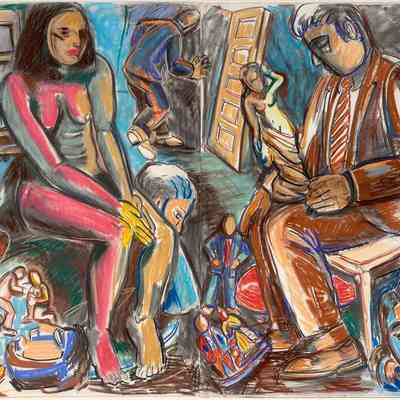
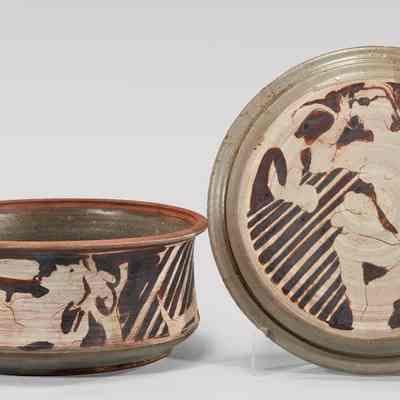
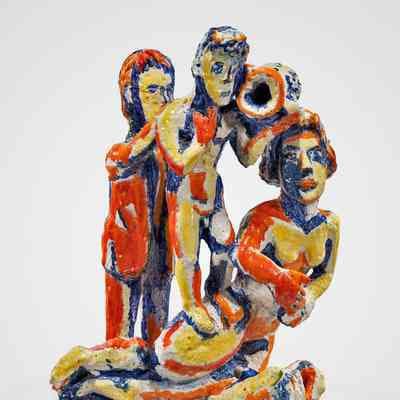
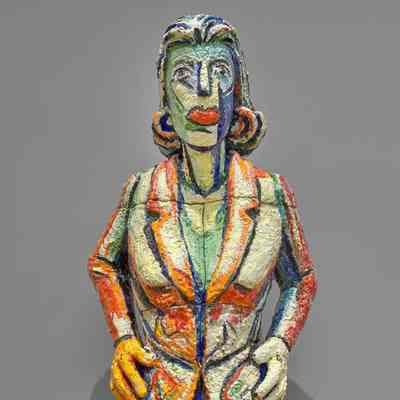
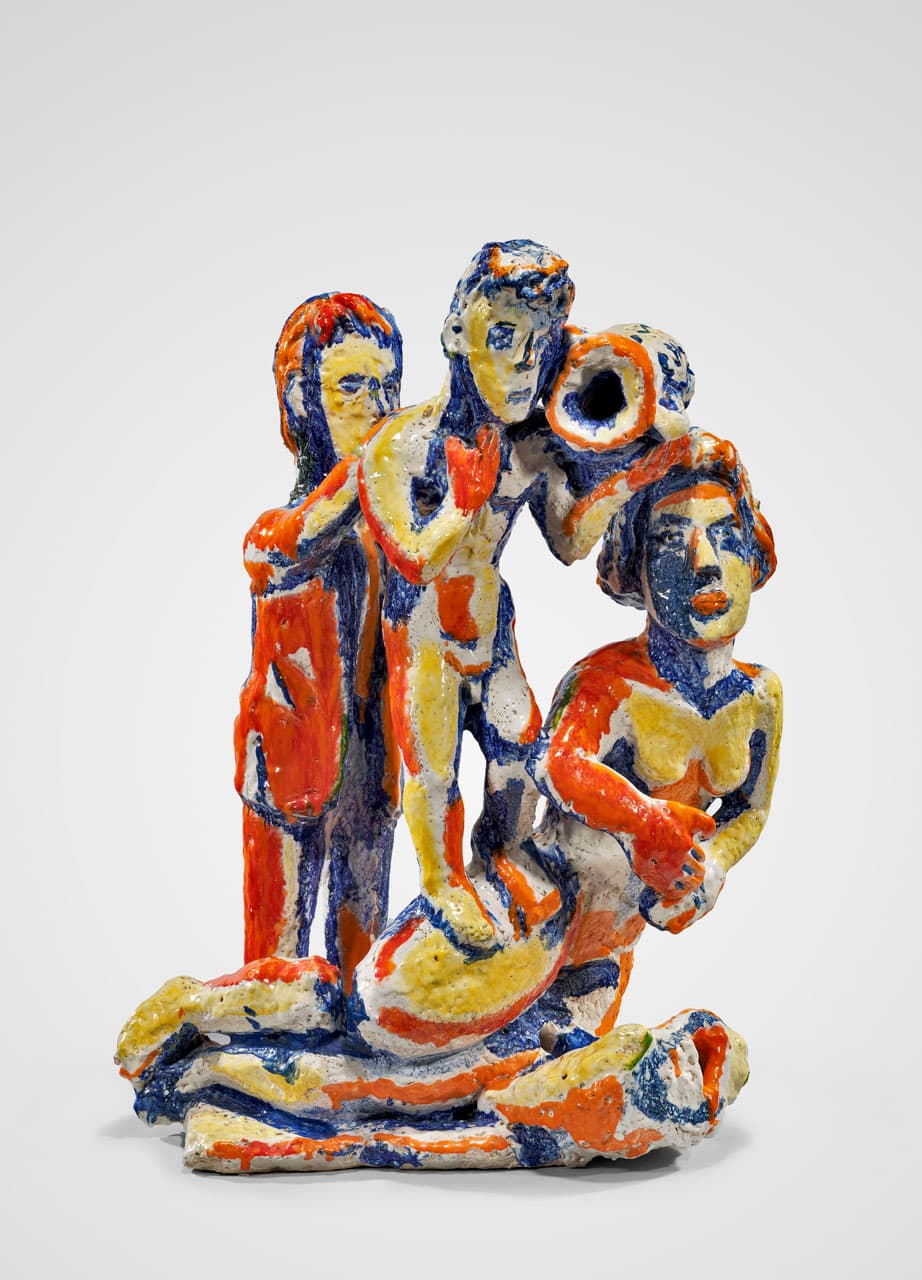
During those years away from the public eye, Frey built what she called an “outline” of her work, solidifying her themes and process while filling her backyard with sculpture, starting with abstraction and moving into work that was primarily figurative. She created life-size sculptures of men wearing blue suits, a symbol of power she said came from the suit, not the man. She also sculpted monumental, powerful women, some clothed and inspired by her grandmother, and others dressed in glaze alone. Frey also made leaps in technical processes, both in sculpting and glazing. She worked “from the ground up,” developing a process of building her standing figures by working with wet clay on top of previously glazed and fired sections, allowing her to have color to which she could respond and react. Focusing on observing and translating local color from the changes in light over time, Frey applied glazes in small sections creating a painterly surface.
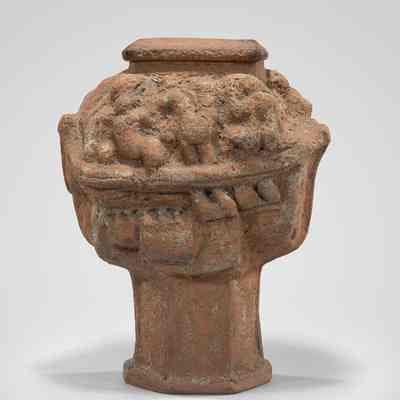
Frey was also an avid collector of what she called “information.” Purchasing clothing, figurines, or other collections of objects that caught her eye, she built a repository to use as the basis for her visual language. These made their way through Frey’s work in the form of mold-made assemblages, figurative sculptures, and drawings and paintings, which were often narrative and provided context for her sculptural works.
In 1981, Frey’s work garnered attention when the Creative Arts League arranged a retrospective that opened at the Crocker Art Museum and toured to six additional locations. This opened the door for a solo exhibition in 1984 at the Whitney Museum of American Art in New York. In the early 1980s, Frey moved her studio to a larger industrial space in Oakland, enabling her to make larger work. As Frey’s figures became more monumental, she started to build them in one piece before using saws to take them apart for firing.
In the 1990s, Frey’s health began to decline, and by 1995 she had suffered two strokes. After teaching at CCAC for nearly forty years, she retired in 1999. Frey was a two-time recipient of the National Endowment for the Arts fellowships and an influence for many California ceramists. In 2000, Squeak Carnwath, Gary Knecht, and Frey founded the Artists’ Legacy Foundation to steward and support the work of artists and artists’ estates. The Foundation took on the role of protecting Frey’s legacy after she passed away from cancer in 2004.
(1) Oral history interview with Viola Frey, 1995 Feb. 27-June 19. Archives of American Art, Smithsonian Institution.
Notes:
About Us. Artists’ Legacy Foundation. https://artistslegacyfoundation.org/about-us/
Chronology, Viola Frey. Artists’ Legacy Foundation. https://violafrey.org/chronology/
Oral history interview with Viola Frey, 1995 Feb. 27-June 19. Archives of American Art, Smithsonian Institution.
Viola Frey Oral history project. 2016 June 16. Archives of American Art, Smithsonian Institution.