Luis Jiménez

American, 1940–2006
About Luis Jiménez
Luis Jiménez (1940–2006) was born and raised in El Paso, Texas. The son of a sign maker, Jiménez worked alongside his father starting at a young age. He studied architecture at the University of Texas for four years before switching his major to Art. After earning his BFA in 1964, he studied briefly at Ciudad Universitaria in Mexico City before returning to El Paso for a short time. In 1966, he moved to New York to pursue an art career. He worked as a social worker serving underprivileged neighborhoods for most of his time in New York and had a short-lived apprenticeship with the sculptor Seymour Lipton (1903–1986), where he mainly worked with metal.
When Jiménez first began working with fiberglass in the 1960s, he did so purposefully, highlighting the material more associated with hot tubs and hot rods over bronze and steel. In doing so, he was not unlike contemporaries such as Claes Oldenburg with vinyl, Tom Wesselmann with vacuum-formed plastic, and Bruce Beasley with cast acrylic. Also unique to Jiménez’s sculpture was his use of commercial airbrushing techniques to paint his sculptures with sparkling, metallic color.
In 1969, Jiménez drove some of his fiberglass sculptures to Castelli Gallery in New York, and arranged them on pedestals in the space, which was empty and between shows. This unconventional method shocked and impressed associate director, Ivan Karp, who recommended Jiménez try showing his work at the nearby Graham Gallery. Jiménez had his first solo show there in 1969 and his second at OK Harris Gallery, operated by Karp.
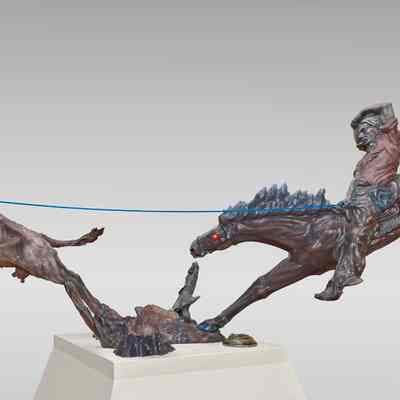
In 1971, Jiménez applied to a commission for a large mural in the lobby of a bank building in El Paso. Feeling a pull toward images of his childhood home and the American Southwest, he started a set of drawings that became the Progress series. Since he wasn’t awarded the commission, Jiménez focused on producing a piece he had already sculpted in clay, End of the Trail. Unable to afford the cost of casting the work, Jiménez sought out Donald Anderson, founder of Roswell Artist-in-Residence Program (RAiR), in Roswell, New Mexico. Once again bringing his sculpture for a surprise showing, Jiménez approached Anderson with a proposal to fund the creation of the sculpture by either purchasing the work or as an advance for the cost of creation. Anderson agreed to fund Jiménez’s sculpture and became a long-term patron.
Through his connection to Ivan Karp, Jiménez was offered, and accepted, a position teaching sculpture in New Paltz, New York. Before starting, Jiménez visited Anderson in Roswell, where the latter offered to fund the production of Jiménez’s Progress sculptures if he would stay in Roswell. The offer started as a RAiR grant and involved Anderson paying Jiménez a living allowance and providing a studio, living space, and assistants. Jiménez canceled his plans in New Paltz and moved from New York to Roswell. Starting with the Progress sculptures, Jiménez began exploring themes regarding the peculiarities of border life, cultural assimilation, and an abiding respect for nature. Works exploring such themes, vibrantly colored and often unnerving, were his focus for the remainder of his career.
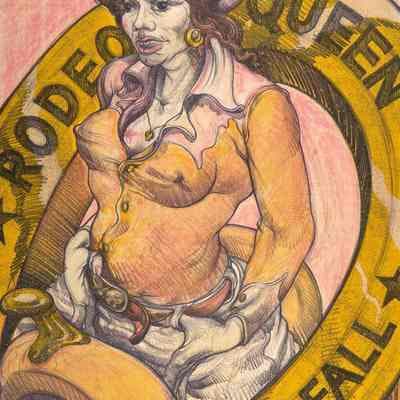
Jiménez also created color lithographs and colored pencil drawings that dealt in similar themes to his sculptural work. These included scenes showing quintessential aspects of Latino identity and culture, images of cowboys, the Southwest and US-Mexico border, and works of political commentary and satire.
Jiménez kept a studio in Hondo, New Mexico. He taught at University of Arizona and joined the faculty of University of Houston in 1995. In 2006, Jiménez died during an accident while working on Blue Mustang for the Denver International Airport.
Notes:
Emery, Mike, “ART PROF. JIMENEZ REMEMBERED FOR WORKS, PERSONALITY.” UH Today News, June 19, 2006.
https://uh.edu/uhtoday/2006/06june/061906ljimenezobit.html
Oral history interview with Luis Jiménez, 1985 Dec. 15-17. Archives of American Art, Smithsonian Institution.
https://www.aaa.si.edu/collections/interviews/oral-history-interview-luis-jimenez-13554
Shields, Scott A., ed. The Crocker Art Museum collection: unveiled. Crocker Art Museum, 2010.
Wikipedia contributors, "Luis Jiménez (sculptor)," Wikipedia, The Free Encyclopedia, https://en.wikipedia.org/w/index.php?title=Luis_Jim%C3%A9nez_(sculptor)&oldid=1308130514 (accessed October 2, 2025).