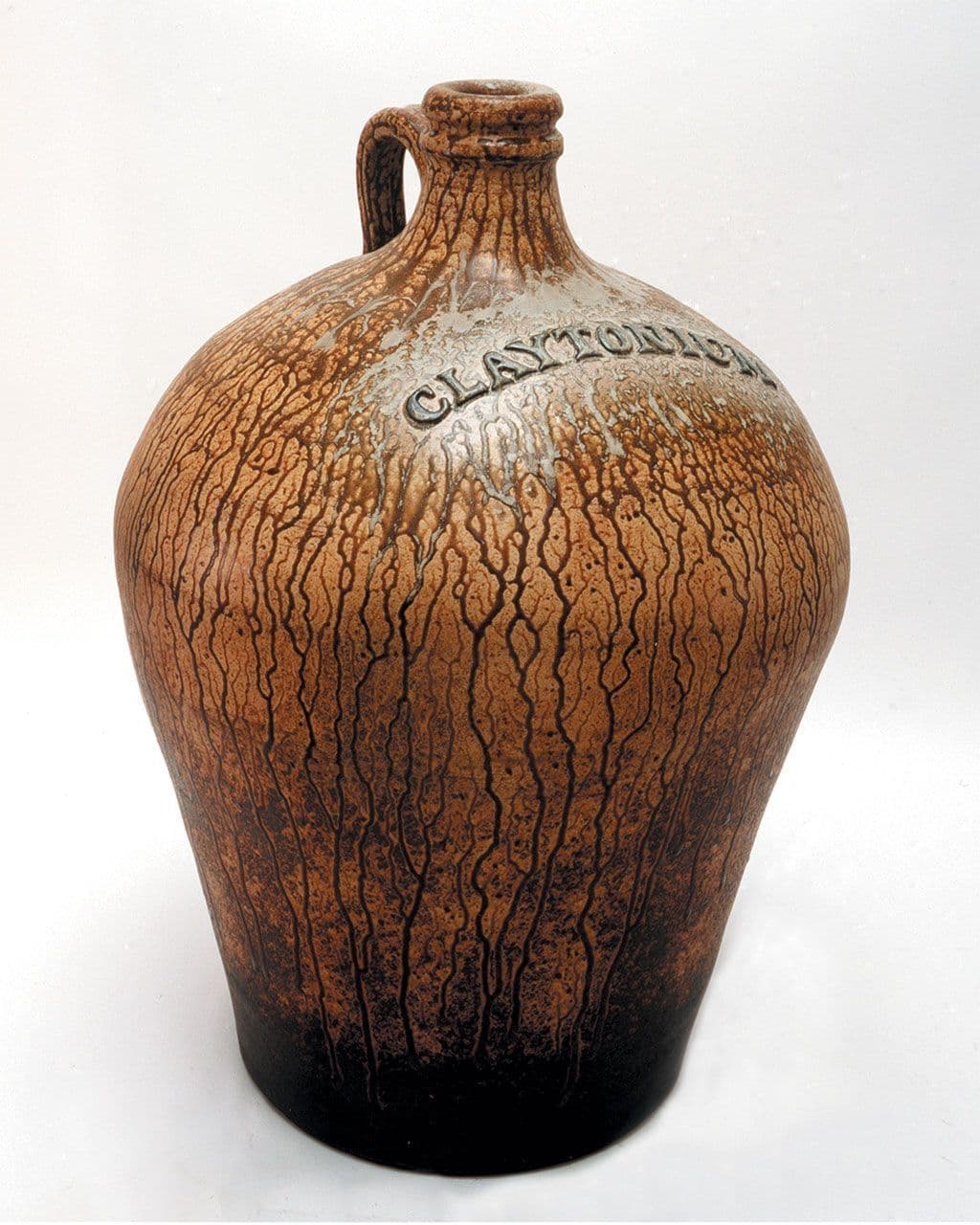
Claytonium Bottle, 1991.
Clayton Bailey (American, 1939–2020)
Stoneware with tobacco-spit glaze, 36 in. x 27 in. (diam.), Crocker Art Museum, gift of Mrs. Robin Liebes and Bailey and Sydney Liebes, 2010.11
Clayton Bailey has always resisted tradition. Although he trained with ceramist Toshiko Takaezu and became an accomplished in clay, Takaezu says Bailey “didn’t care what others were doing. He just wanted to express himself in his own unique, creative, bizarre and humorous way.” (1) California in the late 1960s was thus the perfect place for Bailey's irreverent wit, and in the Bay Area he and his family found a group of like-minded, California Funk artists. Unique among them, Bailey invented a world of wonders at his home and studio in Port Costa, a 40-year labor of creativity and personal vision.
A self-proclaimed "mad scientist" complete with alter ego — Dr. George Gladstone — Bailey aimed to surprise and delight with his art and personality. Serious work happened in Port Costa, but also fun, including the artist’s “discovery” of rare earth elements. One, Claytonium, is the secret to Bailey’s “superpowers,” while the elusive Unobtainium is its chemical nemesis. So scarce is Claytonium that this 50-gallon bottle, contents identified by bold, raised lettering, is a one-of-a-kind creation.
(1) G. Joan DePaoli and Dr. Gladstone, Clayton Bailey: Happenings in the Circus of Life (Davis, CA: John Natsoulas Press, 2000), 19.
LOOK FOR: The traditional tobacco-spit glaze, which is named for its drippy, brown appearance.
Details
- artist/cultureClayton Bailey
- nationalityAmerican, 1939–2020
- titleClaytonium Bottle
- date1991
- mediumStoneware with tobacco-spit glaze
- dimensions36 in. x 27 in. (diam.)
- credit lineCrocker Art Museum, gift of Mrs. Robin Liebes and Bailey and Sydney Liebes
- accession no.2010.11
- collectionModern and Contemporary Art, Ceramics