Taking Flight from Sacramento State
October 2, 2026
How Suzanne Adan’s early success as an art student propelled her creative career.
Large plywood black birds with oversized orange noses, as peculiar as they are comical, are perched above the two galleries housing Suzanne Adan’s retrospective I’m No Spring Chicken. Dogs, snakes, numbers, and letters float freely over the exhibition’s didactic, while long canvasses and clay sculptures in the hallway inform patrons that behind the nearby gallery doors, a new world created by Adan awaits.
The exhibition begins inside the McHenry Works on Paper Center gallery, to the left of the exhibition’s exterior title. Here, the early works that launched Adan’s career while pursuing her BA and MA at Sacramento State are showcased. These include her series of paintings on butcher paper and hand-thrown clay sculptures made in classes taught by Ruth Rippon.
In the following excerpt from the I’m No Spring Chicken catalogue, Scott A. Shields, PhD, the Museum’s Ted and Melza Barr Chief Curator & Associate Director, details Adan's early work shown in this space. Learn what inspired Adan's approach, the role of Folsom’s influential Candy Store Gallery, and the moment when Adan’s decades-long creative relationship with Chicago-based artist, Gladys Nilsson, began.
Explore Adan's retrospective, I’m No Spring Chicken, through October 11.
Panty Hose
Betty Friedan’s 1963 book The Feminine Mystique was inspirational for Adan, as it acknowledged the dissatisfaction that she and millions of other women felt about being relegated to narrowly defined roles as homemakers and mothers.
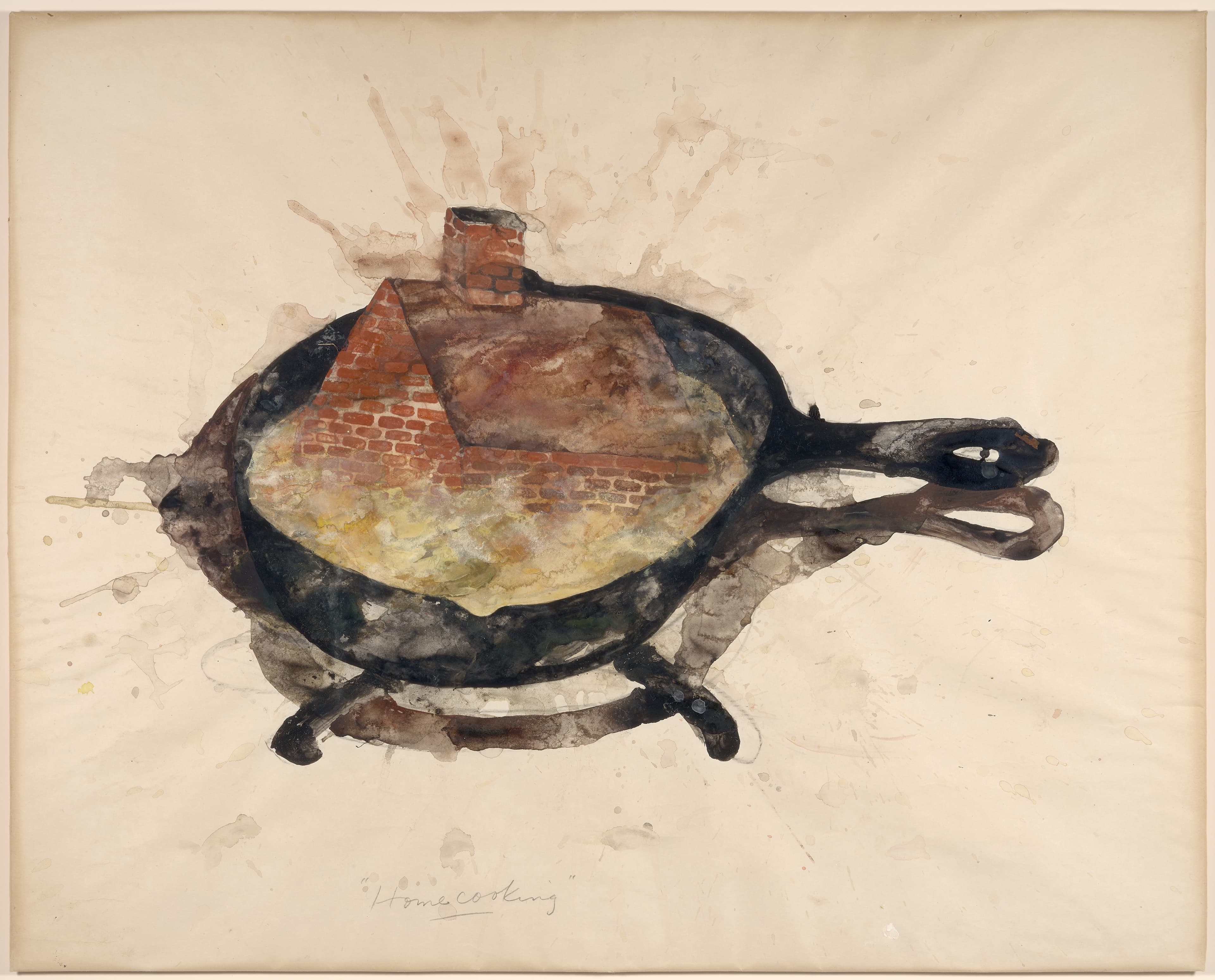
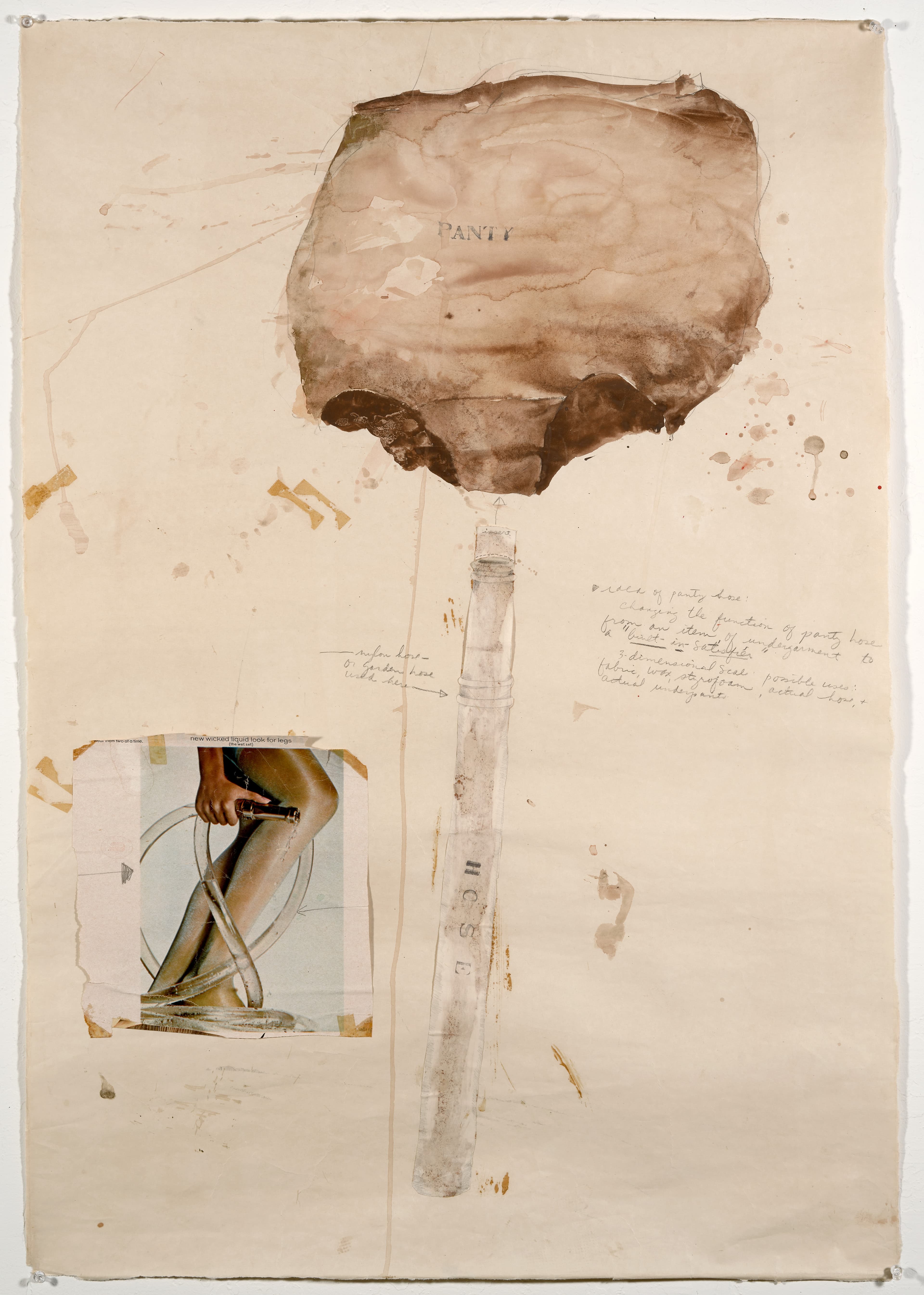
When Adan began her series of watercolors for her thesis project, she hoped to use imagery that would be both familiar to women and have sexual and social connotations in a male-dominated society. Taking cues from her mentors, she invested her work with satire, not-so-subtle witticisms, and puns, using the artworks’ titles to create double entendres or complete the joke. Works generally consisted of loosely painted depictions of one or two objects in watercolor mixed with glue, the technique learned from Jerald Silva and made on the floor to better create puddles and drips that contributed a shambolic spontaneity and fluidity to the results. That Adan worked on butcher paper was a matter of practicality, as she could source it from the art department for free. Most of the objects portrayed were associated with women and given additional meaning through handwritten explanatory text, use of rubber stamps, and, sometimes, magazine cut-outs or other collage elements.
Adan completed her first piece in the new series in February 1969 and titled it Panty Hose. To make it, she cut out a photo from a magazine depicting a woman wearing pantyhose and holding a hose, pairing this image with her own painting of panties, a hose, and rubber stamp letters spelling out PANTY and HOSE, along with written inscriptions. “It was a spoof on pantyhose . . . a fairly new invention for women,” she explained. “The miracle of all miracles was the development of ‘the pill,’ giving women the freedom to have control of our own bodies. Another miracle was the invention of ‘pantyhose.’ Women could finally ditch the uncomfortable and insufferable girdle, which we had worn for years.”
A month later, Adan completed a second work in the sequence, Fragment of a Formal Idea. This time, she bought shoes, handbags, and clothing from a thrift store to use as still life props. For this work, she cut an old ballgown in half, rendering the top as the “formal” idea, a satirical reference to art history and critical theory. Because Adan had never owned a formal dress nor been to a prom, she found it amusing and cathartic to cut up a gown and use it in this way. She completed the third and fourth works in the series that April—Debutante Ball Slippers and Pussyfoot Slippers—this time spray-painting thrift-store shoes silver and pink, covering them with melted wax, and then drawing and painting them and providing narratives. In 1970, she made a second version of Debutante Ball Slippers.
Adan’s art was getting noticed, and not just in Sacramento. In 1970, curator Philip Linhares included four of her recent pieces in his 1970 Drawing Invitational Exhibition held at the San Francisco Art Institute. The exhibition was one of many that Linhares curated at the school highlighting innovative and experimental work by emerging and established artists. Thomas Albright, art critic for the San Francisco Chronicle, called out Adan’s work for mention, as did Brenda Richardson, who reviewed the exhibition for Arts Magazine.
News of the recognition made its way back to Sacramento and, in the fall of 1970, Adan was granted a coveted two-semester graduate teaching assistantship in Irving Marcus’s oil painting class.
The Candy Store
It was Marcus who introduced Adan to the Candy Store Gallery, as he was the first artist to exhibit there, and he remained a leading member of the gallery’s stable until 1976. Adan remembers her first trip to the Candy Store in the fall of 1965 to see a show of Marcus’s work. Though disappointed there was no actual candy (she has always had a sweet tooth), she was thrilled with Marcus’s paintings and other artists’ works on display. In early 1971, she began exhibiting there herself, the exposure helping propel her career.
Owned and operated by Adeliza McHugh, the Candy Store Gallery occupied just two rooms of a small house—once a library—in historic Folsom, about twenty-four miles east of Sacramento. McHugh did, in fact, purchase the house with the idea of selling candy, though health authorities shut that down. Undeterred, she converted the space into an art gallery, which delighted (and sometimes disturbed) visitors for thirty years and helped put the whimsical and subversive spirit of artists in the Sacramento region on the art historical map.
McHugh invited Marcus to show at her yet-unnamed venue after seeing his art in a 1962 exhibition at the Crocker Art Gallery. He, in turn, introduced her to Jack Ogden and, later, to Jim Nutt and Gladys Nilsson. All four artists became part of the ultimate “Candy Store Bunch.” Ogden, in turn, introduced McHugh to Robert Arneson and, through him, to other faculty and students at UC Davis. Regular Davis contributors came to include not only Arneson but Roy De Forest, David Gilhooly, Sandra Shannonhouse, Peter VandenBerge, and Maija Gegeris Zack. Don Reich would also join McHugh’s primary roster, and other frequent exhibitors in the gallery’s early days included Robert Else, Ralph Goings, and Jerald Silva. Members of what might be called the gallery’s secondary stable included Luis Cruz Azaceta, Clayton Bailey, Paul Harris, Luis Jiménez, Ben Kypridakis, Tom Rippon, Harold Schlotzhauer, Chris Unterseher, and Joseph Yoakum, as well as Adan and Michael Stevens.
Nutt and Nilsson started showing at the Candy Store Gallery in September 1968. McHugh initially paired the Chicago artists’ two-dimensional works with ceramics by Gilhooly and Arneson. That October, she featured Nilsson’s art again, this time in a two-person show with Reich. The Hairy Who artists brought greater two-dimensionality to the Candy Store’s three-dimensional focus, their penchant for dark absurdity playing nicely with the sculptural work of Arneson and his circle.
Nutt and Nilsson, in turn, helped bring Stevens and Adan deeper into the Candy Store fold, with Adan initially displaying her pun paintings and, subsequently, her ceramic sculptures. In January 1971, Nutt and Nilsson curated a show that included their own work, as well as that of Adan, Stevens, Victor Faccinto, Joan Moment, and Peter Stegall. Adan and Stevens also exhibited with Nutt and Nilsson as a foursome in October–November 1975, a show that took place shortly before the senior couple returned to Chicago. Despite the distance, in late 1976 Nilsson and Adan opened a two-person show at the gallery, and the group of four came together again in October 1977 and, with other artists, in April 1978.
Suzanne Adan: I’m No Spring Chicken is on view through October 11. The exhibition catalogue is available in the Museum Store.