A Dangerous Beauty: Power and Identity in Lucas Cranach’s Judith
March 3, 2026
by Sarah Farkas, Associate Curator of Art
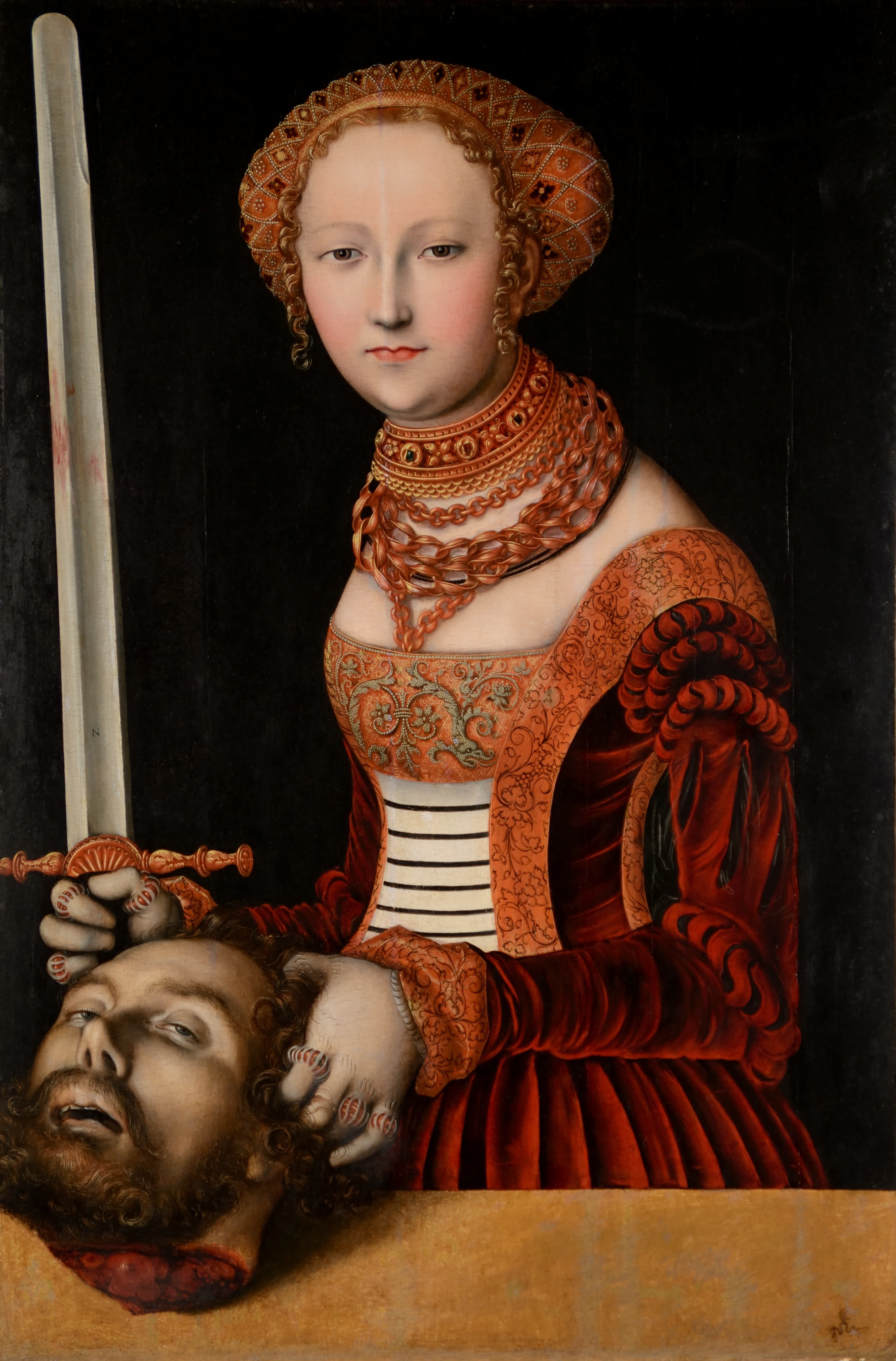
Recent visitors to our new exhibition, The Sense of Beauty: Six Centuries of Painting from Museo de Arte de Ponce, have been stopped in their tracks by an arresting, beautifully adorned woman gripping a blood-streaked sword and a ghastly severed head. This is Judith [Fig. 1], the biblical Old Testament heroine, who saved her people by daring to approach the tyrant and Assyrian general, Holofernes—enticing and intoxicating him before ultimately beheading him as he slept. To medieval and early modern Christians, Judith was both a paradigm of virtue, as well as a cautionary tale of the so-called “power of women.” Unsurprisingly, her dramatic story of cunning and violence was a popular subject among artists. The Judith with the Head of Holofernes in this exhibition is one of nearly three dozen versions attributed to the Cranach workshop alone. These various Judiths were not merely popular; they also reveal how German Protestants eagerly sought out a new, distinct visual culture at a pivotal moment in history—the dawn of the Reformation. As a close friend of and collaborator with Martin Luther, Lucas Cranach the Elder was the leading artist defining this new identity.
The Cranach Workshop
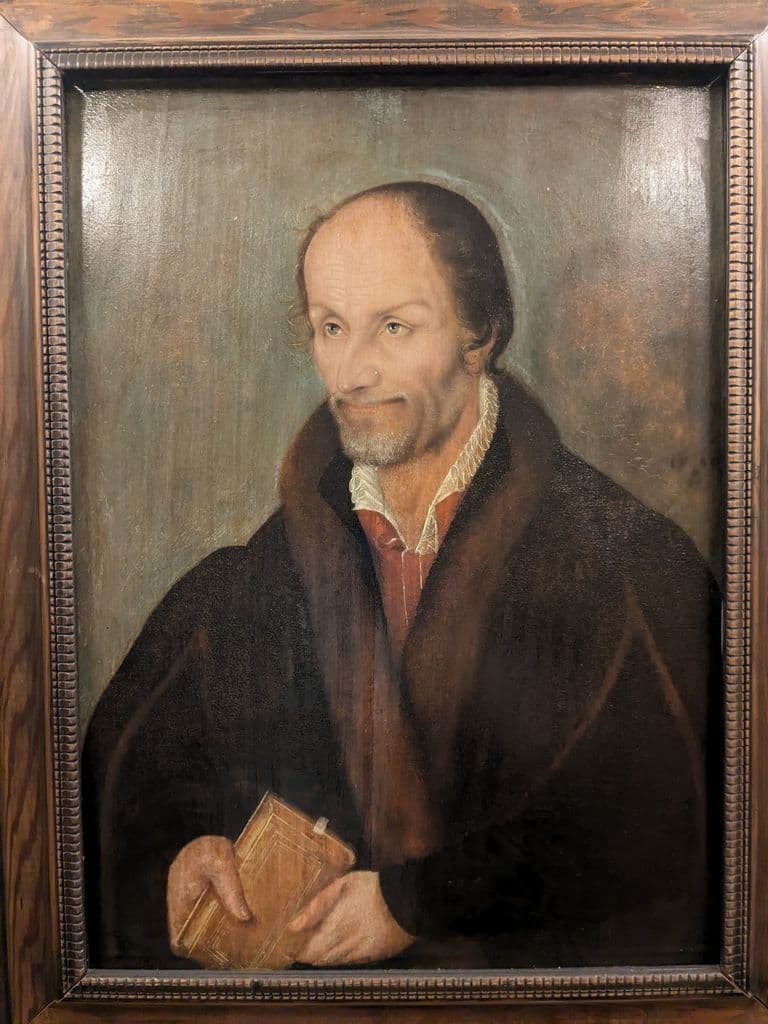
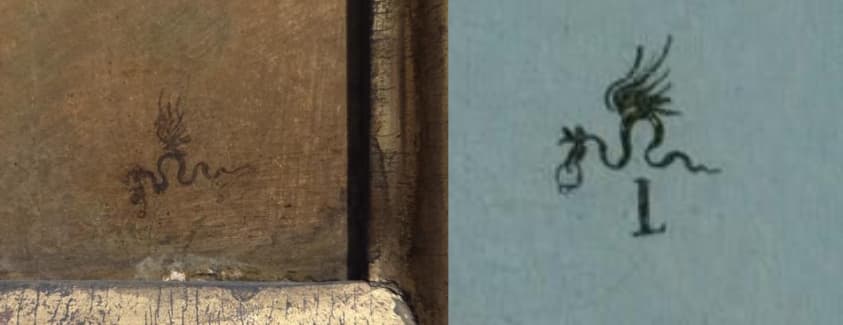
Like many artists in the early modern period, Lucas Cranach relied on a vast workshop of assistants to achieve his impressive artistic output. There are thousands of extant painted panels attributed to Cranach and his workshop—including many by his second son, Lucas Cranach the Younger, who gradually assumed leadership of the Cranach workshop before the elder’s death in 1553. The Cranachs relied on several methods of standardization. The wood panels, for instance, on which their artworks were painted, were produced en masse in consistent sizes. The artists also relied on patterns, particularly for portraits, which could be reused to reproduce multiple versions of the same sitter. For example, the face types established for the early reformers Martin Luther and Philip Melanchthon can still be found in collections worldwide, such as this one in the Crocker’s permanent collection [Fig. 2]. To keep tight control of the Cranach brand, workshop products were emblazoned with a unique signature or insignia, a serpent with small, bat-like wings carrying a ring; a personal symbol granted to Lucas Cranach the Elder by his most important patron, Frederick the Wise, Elector of Saxony. This insignia is also an essential tool for art historians charged with attributing and dating Cranach’s paintings. Early works produced by Cranach have the insignia with raised wings [Fig. 3], while works made after the death of Cranach’s eldest son, Hans, in 1537 bear the serpent with lowered wings [Fig. 4], a tragic memorial by a grieving father. It is therefore assumed that Museo de Arte de Ponce’s Judith was produced before 1537, because it includes the raised-wing insignia in the lower right-hand corner.
German Identity in the 16th Century
Cranach’s authorship is obvious not only because of his insignia, but also the distinct visual language he defined in the early 16th century. The Ponce’s Judith is instantly recognizable as a Cranach due to her characteristic costuming and jewelry modeled on the fashions of early 16th-century Germany. Judith wears a typical red-and-orange embroidered gown, often worn by the women of the princely-electoral court of Saxony, for which Cranach was the official court painter. Sibylle of Cleves, the wife of the Saxon Prince-Elector John Frederick the Magnanimous, wears similar gowns in her official portraits by Cranach from the 1520s and early 1530s [Figs. 5 and 6].
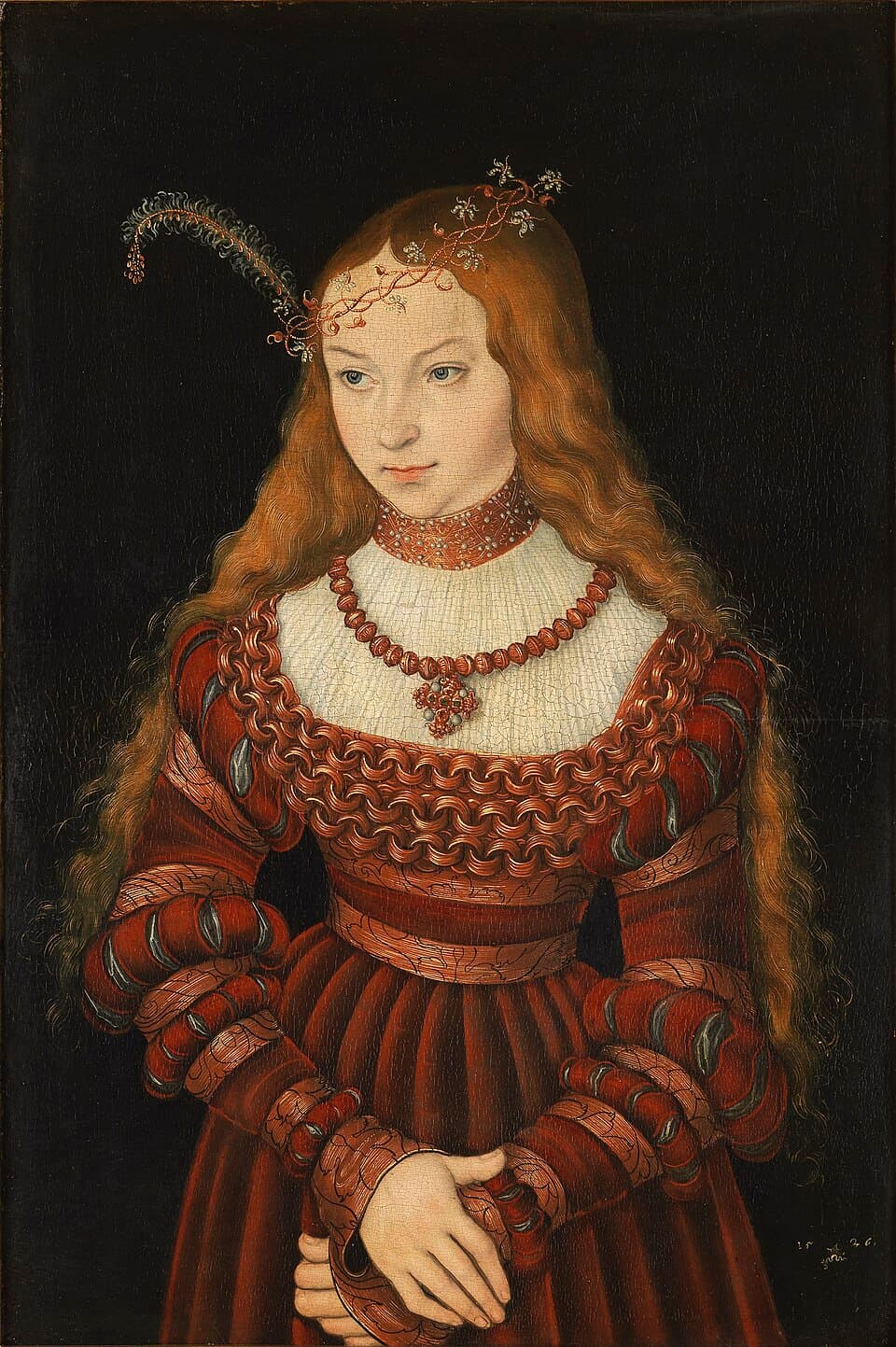
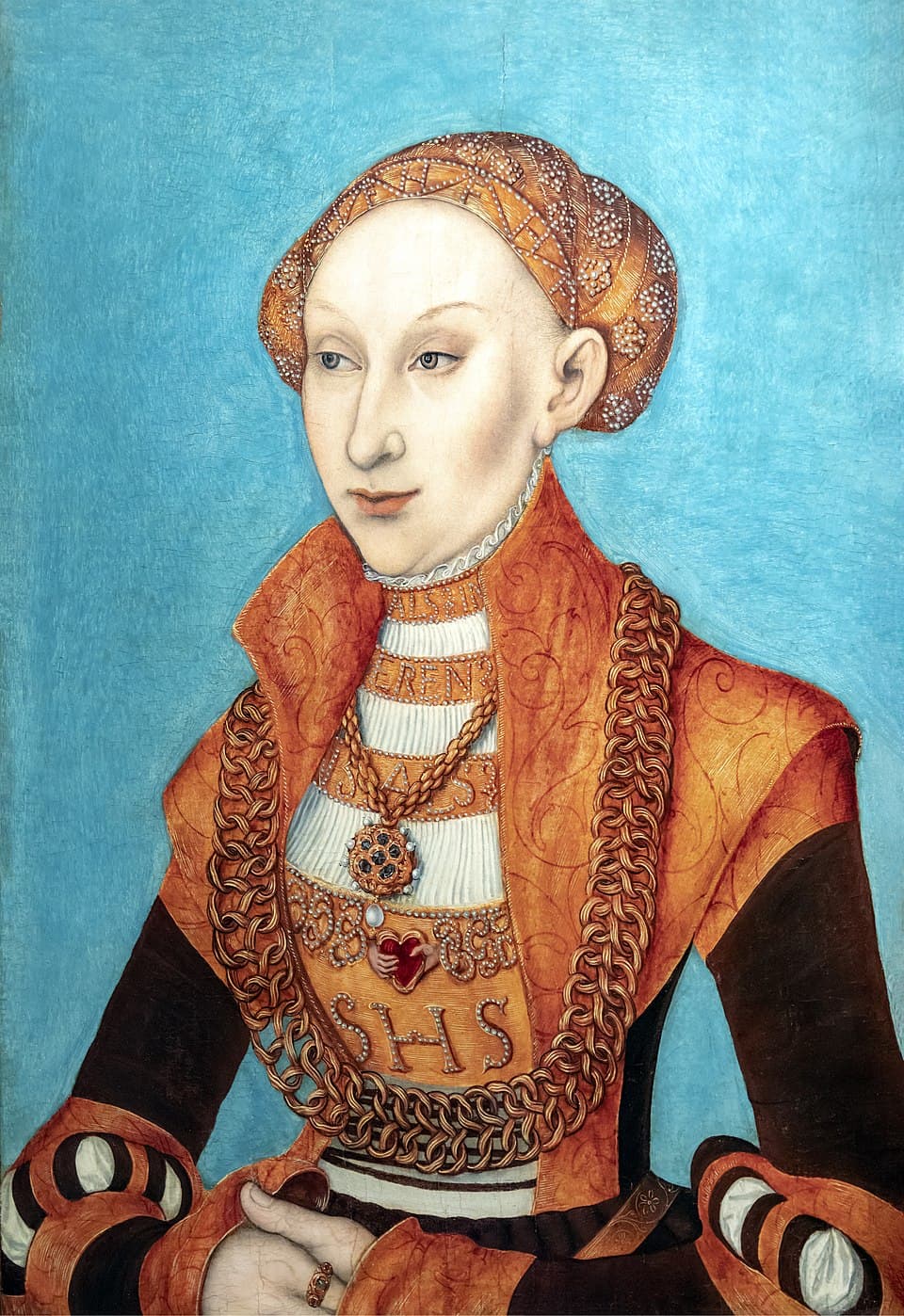
The 1532 portrait, created shortly after her husband’s ascension to the role of elector, shows Sibylle in an elaborate Goldhaube or cap, embroidered with pearls, not dissimilar to Judith’s. High-ranking married women in Germany traditionally wore these caps as a symbol of their piety and status. The many slashes in the Ponce’s Judith’s sleeves and gloves reveal luxurious fabrics and jeweled finger rings, a not-so-subtle reminder of princely wealth. Layer upon layer of Hobelspankette—a “ribbon chain” of interlocking loops forming a necklace, popular among men and women—surround Judith’s throat and cover her collarbone like a type of battle armor. Both glamorous and practical, each link could be removed and melted down for its stored value when necessary. Moreover, Judith’s attire points to an explicitly Protestant audience, both in the connections with the reformist electoral court dress and the use of an Old Testament heroine as an exemplar—a popular motif among early Protestants.
The Power of Women
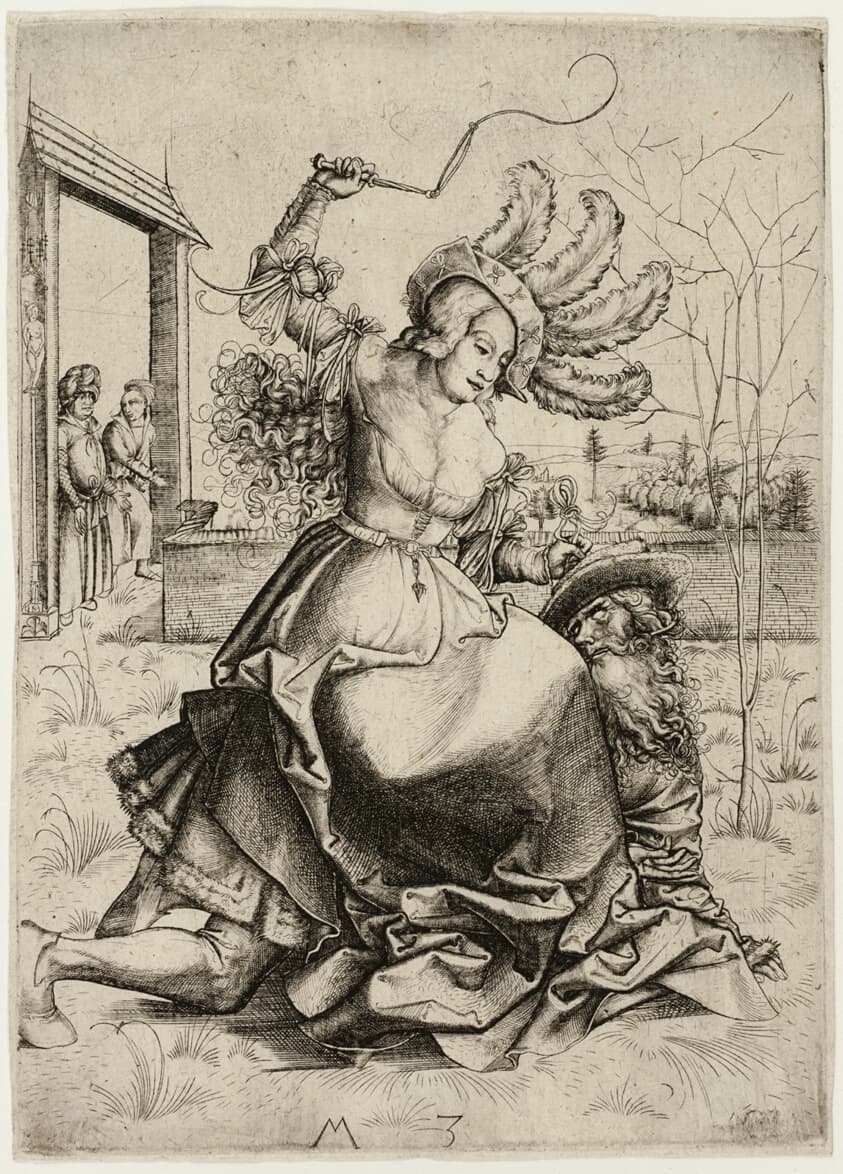
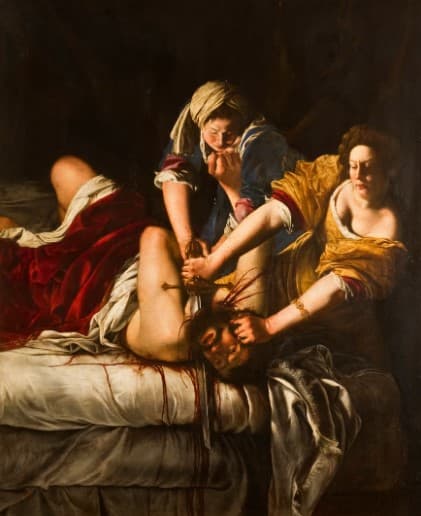
The details of Judith’s dress do more than imagine her as a wealthy 16th-century German noblewoman. They draw attention to the unnerving reversal of power between Judith and her adversary. Judith’s fine clothes and glittering jewels are in jarring contrast to the obvious horror of the severed Holofernes head and the upright blade. The protagonist’s radiant visage, with its direct, placid gaze and cheeks tinged with a pink flush denoting life, juxtaposes Holofernes’s sallow, greying skin and unfocused eyes. She grips his curls with bloodless white gloves in such a way that reveals the gruesome, exposed inner flesh of his neck. She has yet to clean her victim’s blood from her sword. By the early 16th century, Judith was understood as both a model of piety and resolve to Christian women and a dire warning of the power of women to early modern men. Though her cause was righteous, viewers understood that Judith’s plan hinged on her seductive capabilities. The Weibermacht (German for “Power of Women”) was a frequent motif in literature and art in this period, often depicting men overcome by cunning and alluring female adversaries, ranging from the comical, as in the story of Phyllis riding Aristotle [Fig. 7], to the brutal, such as the many interpretations of Judith and Holofernes [Fig. 8]. These stories and images offered the opportunity for society to consider gender roles and often reinforced a patriarchal hierarchy.
Judith Today
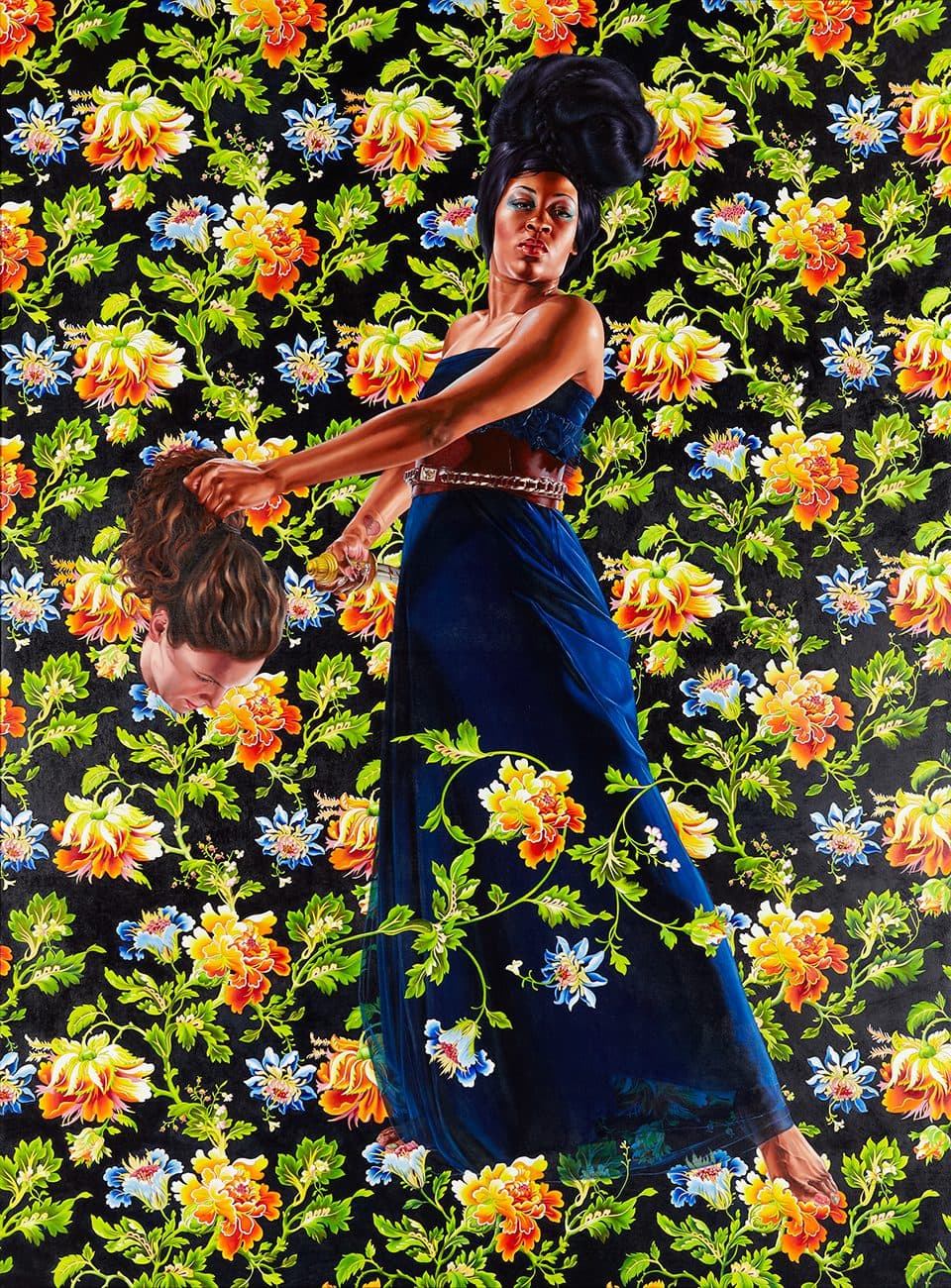
Now, 500 years after Lucas Cranach painted his many Judiths, the theme of Judith and Holofernes in contemporary painting asks similar questions: Who holds power in our society? Who do they wield it against? Can power be challenged? Consider Kehinde Wiley’s Judith and Holofernes (2012) [Fig. 9], in which the head of Holofernes is not the male military figure of the Old Testament, but rather that of a white woman. Wiley’s subject recalls the many iterations of Judith across art history in medieval manuscripts, early modern prints, Cranach workshop panels, and epic canvases by Baroque painters like Caravaggio and Artemisia Gentileschi. He subverts our expectations, however, implying that race, rather than gender, is now the primary arbiter of power.