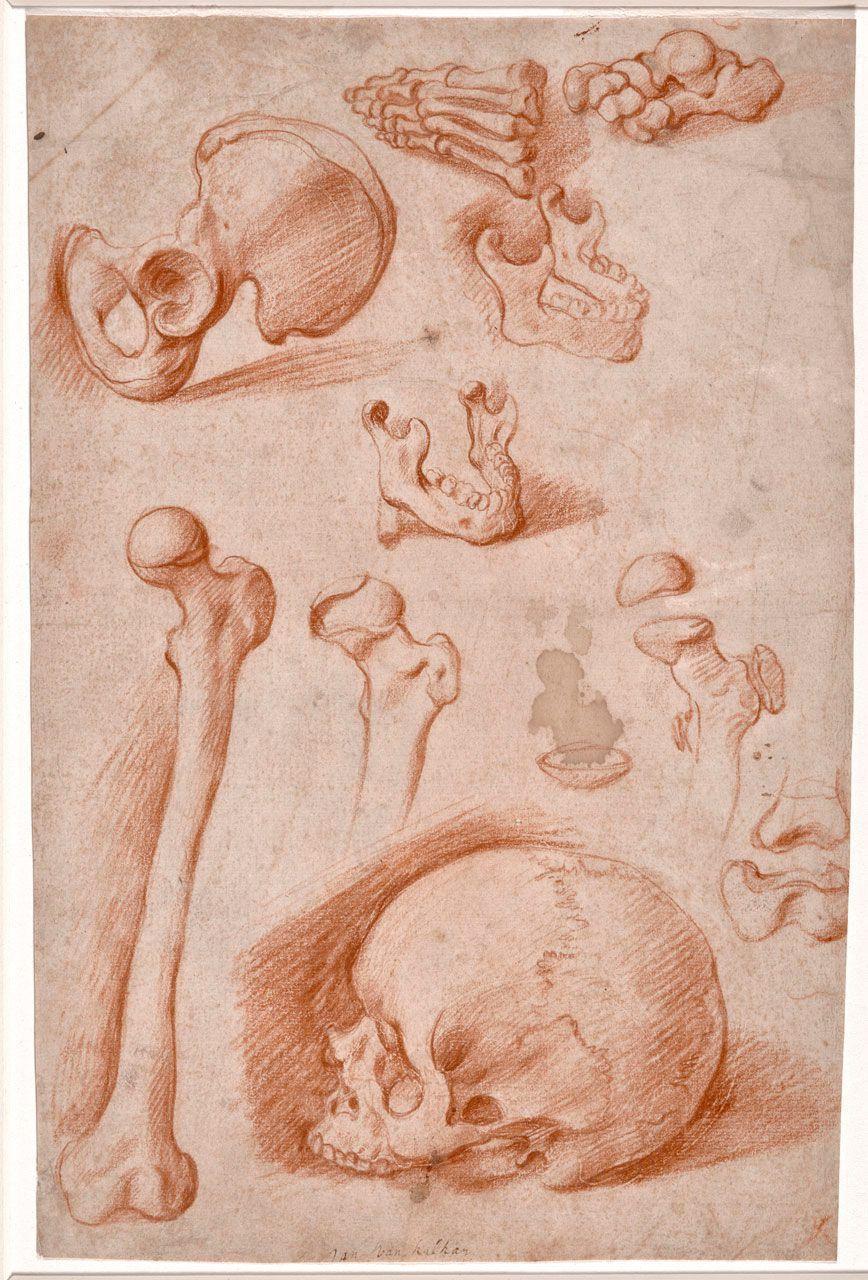
Studies of Human Bones, n.d.
Jan Steven Calcar (Italian, born Germany, circa 1499–1546)
Red chalk, incised on cream laid paper, 11-9/16 in. x 7-3/4 in. Crocker Art Museum, E. B. Crocker Collection, 1871.127.a
Born in Calcar, Westphalia, Jan Steven van Calcar spent his career in Italy. In Venice, he studied with Titian and later lived in Naples, where he befriended Giorgio Vasari. Vasari mentioned Calcar several times in his Vite, praising the northerner’s rare ability to work in an Italian style and naming him as the designer of woodcut illustrations for the works of the pioneering anatomist, Andreas Vesalius.
Although Calcar certainly contributed to Vesalius’s earlier work, Tabulae anatomicae sex (1538), the artist’s precise role in the illustration of Vesalius’s most famous treatise, the De humani corporis fabrica libri septem (1543) is a matter of much debate. The Crocker drawing was not reproduced directly in the treatise, but most of the individual bones appear reversed and rearranged into a tidier composition in Plate IV, Book I, of the Fabrica. The drawing, or more likely its related woodcut, was further adapted by the famous anatomical illustrator Jan Wandelaar (1690–1759) for a later edition of the collected works of Vesalius.
Details
- artist/cultureJan Steven Calcar
- nationalityItalian, born Germany, circa 1499–1546
- titleStudies of Human Bones
- daten.d.
- mediumRed chalk, incised on cream laid paper
- dimensions11-9/16 in. x 7-3/4 in.
- credit lineCrocker Art Museum, E. B. Crocker Collection
- accession no.1871.127.a
- collectionEuropean Art
red chalk, lower right corner, possible monogram: JSK; dark brown ink, center of bottom margin: Jan van Kalkar; verso, graphite, lower margin: Geschenk des Herrn v. Amstetten, Breslau / copirt in Holzschnitt v. A. Kretzchmer für Choulant’s Buch; verso, dark brown ink, upper margin: No. 15
Baron von Amstetten, Breslau; Rudolph Weigel, Leipzig, by 1852(1); Edwin Bryant Crocker, Sacramento, by 1871; gift of his widow Margaret to the Museum, 1885.
William Breazeale, with Cara Denison, Stacey Sell, and Freyda Spira, A Pioneering Collection: Master Drawings from the Crocker Art Museum, exh. cat. Sacramento and tour, 2010, no. 16
Thomas daCosta Kaufmann, Central European Drawings in the Collection of the Crocker Art Museum, Turnhout, 2004, pp. 17–20
Jeffrey Ruda, The Art of Drawing, exh. cat. Flint, 1992, no. 22
David Rosand and Michelangelo Muraro, Titian and the Venetian Woodcut, exh. cat. Washington, 1976, p. 215, note 14
Master Drawings from Sacramento, exh. cat. Sacramento, 1971, no. 15
Jürgen Schultz, Master Drawings from California Collections, exh. cat. Berkeley, 1968, no. 22
Numa S. Trivas, Old Master Drawings from the E. B. Crocker Collection, the Dutch and Flemish Masters, unpubl. ms., Sacramento, 1942, no. 22
Ludwig Choulant, History and Bibliography of Anatomic Illustration, trans. M. Frank, Chicago, 1920, p. 417
Ludwig Choulant, Geschichte und Bibliographie der anatomischen Abbildung, Leipzig, 1852, p. 179, no. 43.