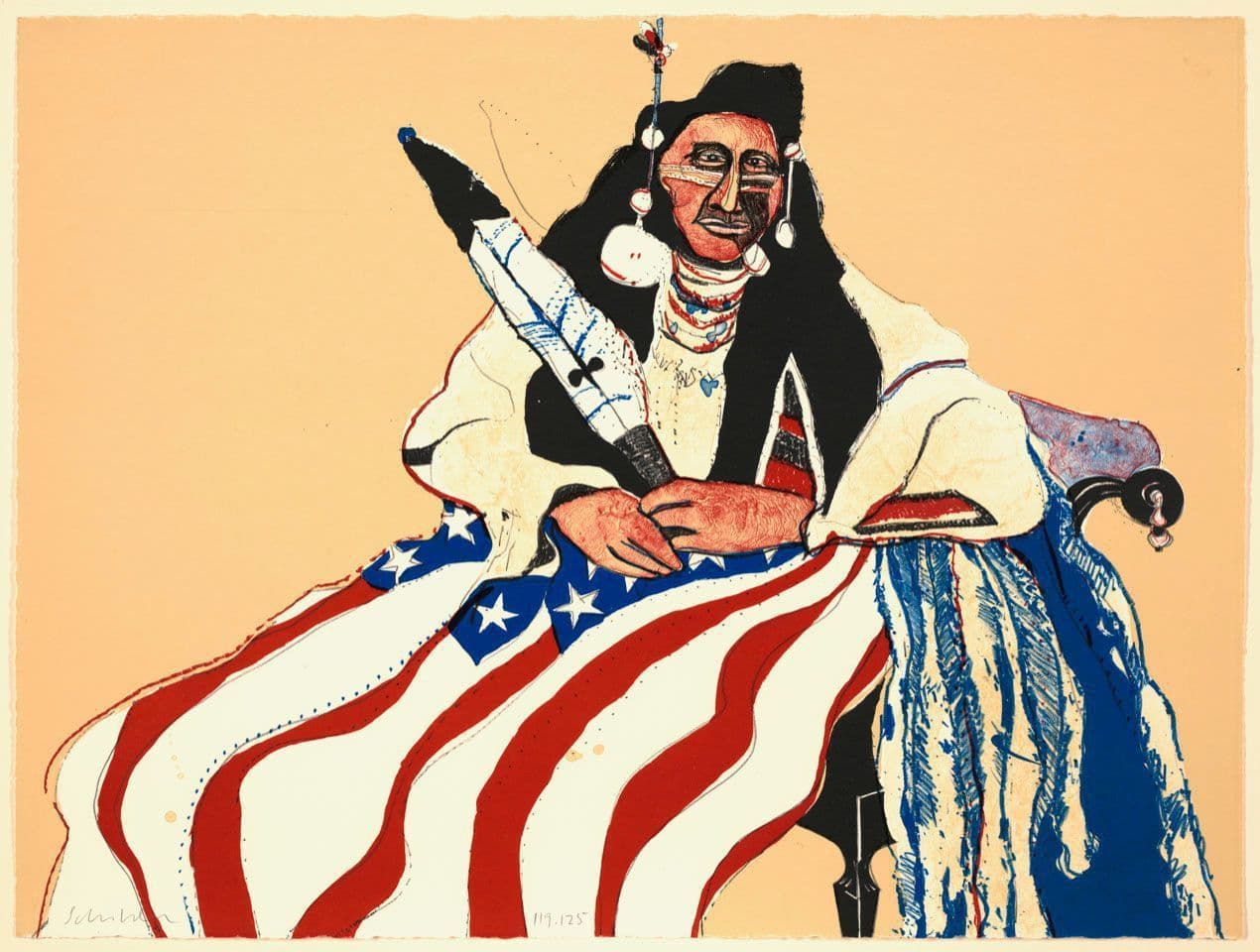
Bicentennial Indian, n.d.
Fritz Scholder (Luiseño, 1937–2005)
Lithograph, 22-3/8 in. x 29-5/8 in. Crocker Art Museum, gift of Lorillard, New York City, 1975.28.12
“I’ve always contended that whatever my current interests are, they show up in my work. This is not a conscious thing, but it has always been there. My life and my art are inseparable, and it is natural for me to express what I am involved with at the time.”(1)
What separated artist Fritz Scholder from other artists offering social critique in the 1960s and 1970s was the isolation of the figure in his color fields. His paintings were emotional and meant to speak over time to universal values. With this process, Scholder exhibits the lessons of Bay Area Figuration and especially the influence of Wayne Thiebaud and Gregory Kondos, with whom he studied in Sacramento.
This lithographic image was created shortly before the 1976 US Bicentennial. It depicts a seated Native American figure with traditional clothing and regalia and an American flag draped across his lap. The lithograph’s irony lies in its relationship to stereotyped images of Betsy Ross (1752–1836), who is said to have sewn the first American flag for George Washington in 1776, though there is no evidence that she actually did so. Ross did, however, sew flags during the Revolutionary War period and for many years thereafter.
(1) Charlene Acevedo, Interview with Fritz Scholder, Fritz Scholder: Paintings and Monotypes (New York: Alexander Gallery, 1991).
LOOK FOR: Glimpses of the 19th-century chair beneath the figure, which underscores the portrait style of the work.
Details
- artist/cultureFritz Scholder
- nationalityLuiseño, 1937–2005
- titleBicentennial Indian
- daten.d.
- mediumLithograph
- dimensions22-3/8 in. x 29-5/8 in.
- credit lineCrocker Art Museum, gift of Lorillard, New York City
- accession no.1975.28.12
- collectionNative American Art, Modern and Contemporary Art